

WSDU-1X16ER
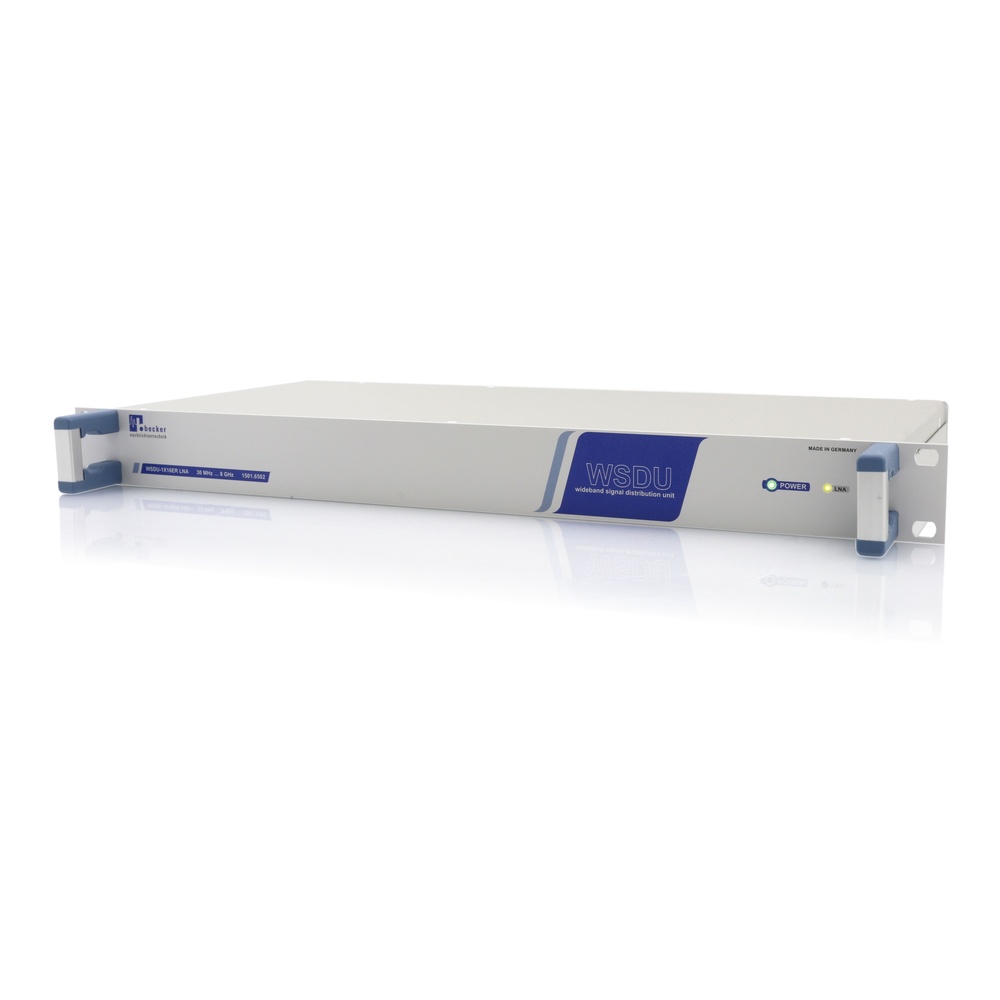
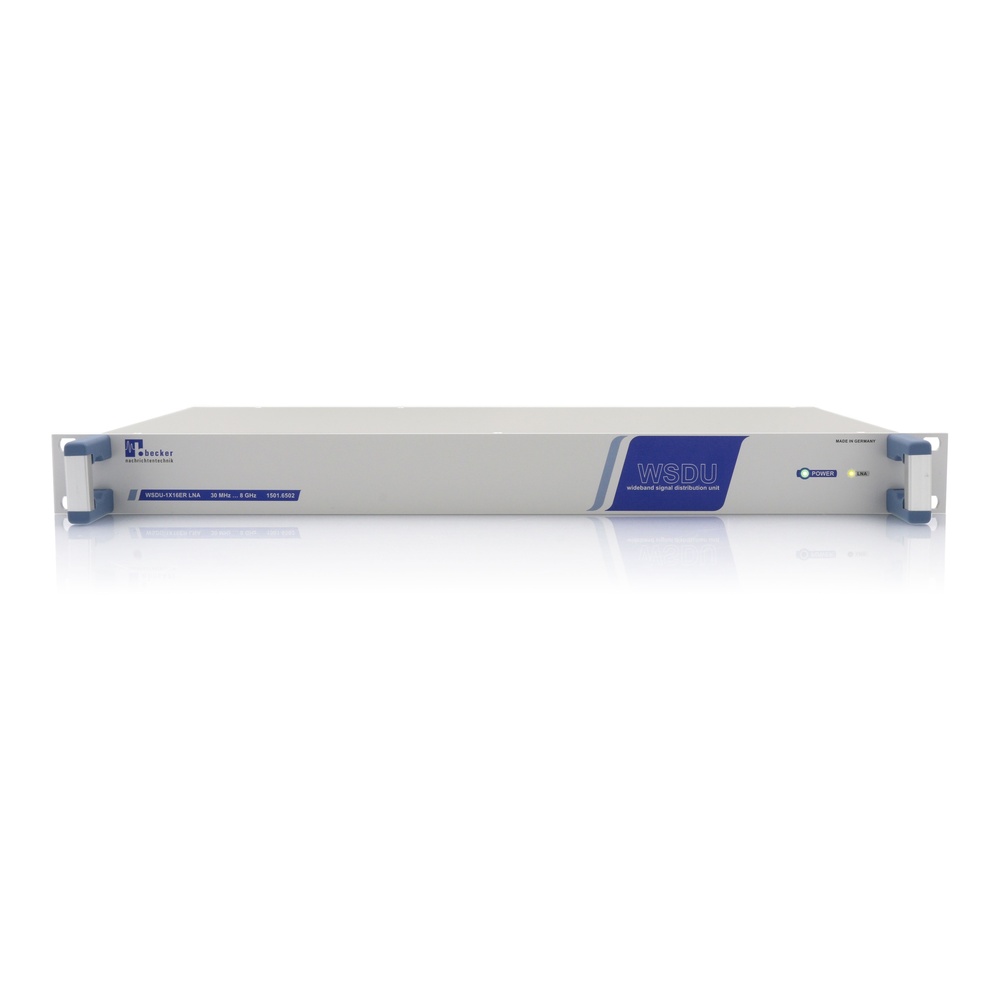
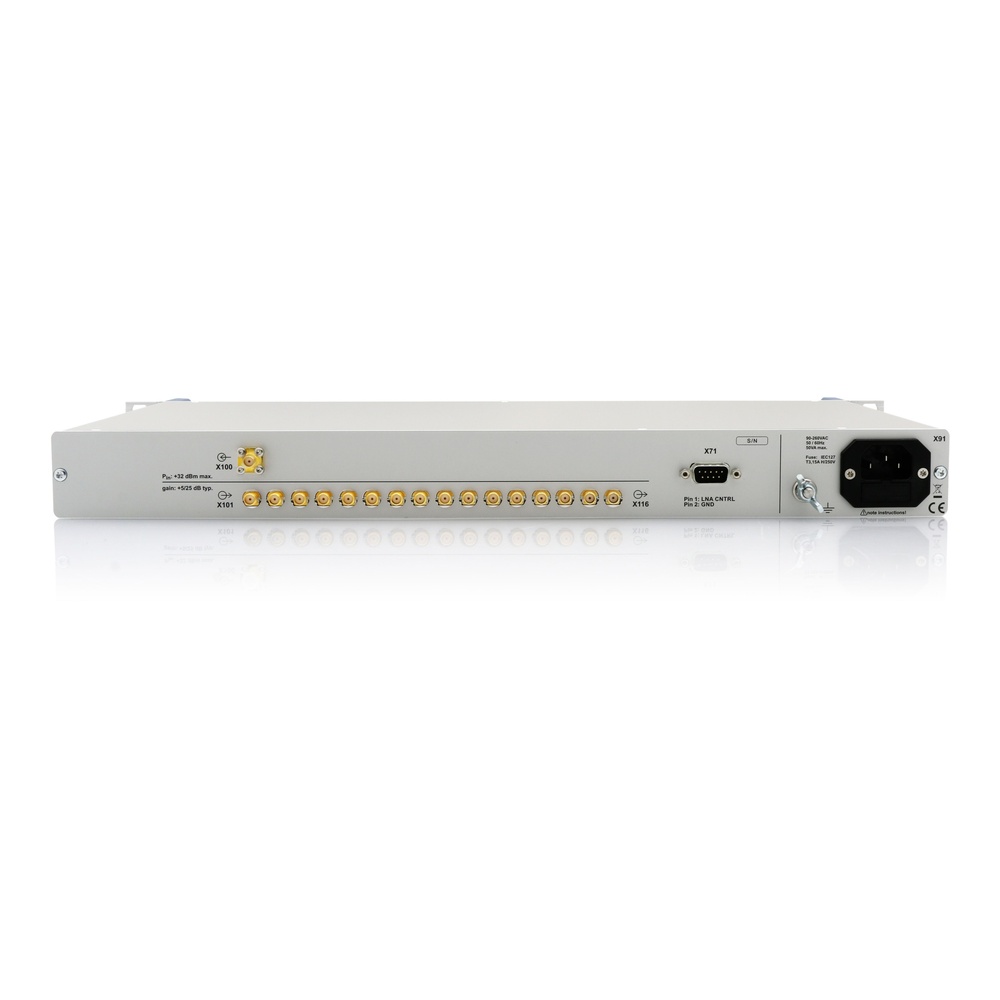
Multicouplers enable the distribution of a single signal to multiple outputs without causing signal level loss or significant distortion. The diverse range of signals in reception applications imposes stringent requirements on the multicoupler's linearity and noise performance. The WSDU-1X16ER_LNA is the perfect solution for contemporary broadband reception systems in spectrum monitoring applications that need to cover a frequency range extending beyond 8000 MHz. The device offers a bypassable Low Noise Amplifier at the input port to further extend the dynamic range.
19", 1U radio monitoring 30...8000 MHz 1 input, 16 outputs
Input Signal Clipper
To protect the RF input against very strong RF signals in the close environment coming e.g. from mobile phones the WSDU-1X16ER_LNA has an input signal clipper. RF signals up to 1.5 W can be fed in the RF input without destruction of the device. In the case of overdriving the distribution amplifiers caused by too much RF input level the power LED indicates the compression in LNA OFF mode.
Low Noise / Low Distortion Mode
The signal at the input is amplified by using broadband low-noise amplifiers with a wide dynamic range - weak signals are linearly amplified even if they occur next to signals with very strong levels. As a result, the distributed input signal is made available at the 16 outputs without any loss in level. The hardware structure of the distribution offers optimal phase and amplitude balance performance. All inputs and outputs have SMA female connectors.
VLF und HF Suppression
For the use in VHF, UHF and SHF receiving systems strong signals from i.e. local medium wave radio stations must be suppressed. The WSDU-1X16ER_LNA offers an integrated high pass filter for an effective suppression of frequencies less than 5 MHz.
High Port-to-Port Isolation
WSDU-1X16ER_LNA features a high port-to-port isolation at the outputs. The connected receivers are prevented from affecting each other, e.g. via local oscillators or synthesizers.
Latest modification: 25.08.2026